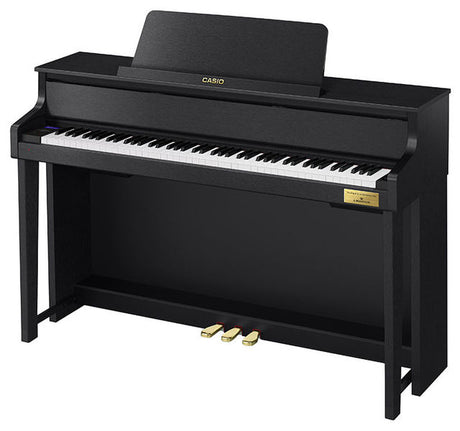
The Casio GP-310 sits in a segment usually shared by Yamaha, Kawai and Roland: the hybrid piano. Its promise is to combine the playing feel of an acoustic grand with the maintenance-free nature of a digital piano. What makes the GP-310 special is its origin in a collaboration with piano maker C. Bechstein.
In this spotlight we look at the three building blocks that carry the instrument: the keyboard, the sound engine and the speaker concept. We close with the key question of who the GP-310 is right for and where its limits lie.
01What sets a hybrid piano apart from a digital piano
A classic digital piano simulates the touch with weighted plastic keys. A hybrid piano like the GP-310 goes one step further: it uses a real piano action with wooden keys that move a hammer just like an acoustic instrument. Strings and a soundboard are absent, however, and the tone is generated digitally. Two practical benefits follow, namely tuning stability without an annual tuning and a freely adjustable volume right down to headphone playing.
The distinction from a silent piano matters: a silent instrument is a full acoustic piano with strings whose hammers can be stopped on demand. The GP-310 has no strings, it is a hybrid by design with a piano action and digital sound. If you want to explore the difference, you will find it in our article on how hybrid pianos work in general.
02The keyboard: Natural Grand Hammer Action with Bechstein heritage
The heart of the GP-310 is its Natural Grand Hammer Action. The keys are made from solid wood at full grand-piano length, and Casio builds them with the same materials and processes used for C. Bechstein concert grands. A keypress sends a hammer along the same vertical path as in a grand piano, with comparable weighting and pivot points.
The result is a touch noticeably closer to an acoustic grand than the usual mid-range digital keyboards offer. Especially for players who move between an acoustic instrument in lessons and their own piano at home, this closeness in feel is the real advantage.

03Three grands inside the instrument: Berlin, Hamburg, Vienna
For its sound, Casio uses the in-house AiR Grand sound source with 256-voice polyphony. Three concert grands with distinct characters are modelled, named after their cities of origin: Berlin, Hamburg and Vienna.
The Berlin grand was developed in collaboration with C. Bechstein and is modelled on the brand flagship, sounding clear and transparent. The Hamburg grand aims at a rounder, more carrying concert tone familiar from the wider repertoire. The Vienna grand goes for a warm, chamber-music timbre suited to classical literature. These three base colours give the player a genuine tonal choice rather than a single preset.
| Tone colour | Character | Best for |
|---|---|---|
| Berlin | Clear, transparent, developed with Bechstein as the model | Soloistic, transparent playing |
| Hamburg | Full, round, carrying | Romantic and concert repertoire |
| Vienna | Warm, chamber-like | Classical literature, quiet passages |
04Sound in the room: the Grand Acoustic speaker system
So that the modelled grand comes alive in the room, the GP-310 uses a six-way speaker system. It aims to recreate the spatial sound field an acoustic grand produces in a room, so the tone does not arrive flat from a single box but surrounds the player.
The cabinet reflects the same ambition: the GP-310 is built as a console instrument in living-room format, with a lift-up lid and a look closer to a piece of furniture than to a stage device. For home playing that is exactly the right form factor. We offer the model in matte black and matte white.

05Who the GP-310 is right for
The GP-310 is aimed at players with clear expectations of the action, for whom a classic digital piano no longer suffices, but who deliberately choose a maintenance-free instrument. These are often advanced students, returning players and parents looking for an instrument for an ambitious child whose touch does not feel like a compromise.
Within the hybrid segment, the GP-310 positions itself as the more accessible entry point. Models with an original action such as the Yamaha AvantGrand or the Kawai Novus line sit above it in price and concept. Compared with premium digital pianos, the GP-310 offers a markedly more realistic piano action, at a corresponding surcharge. Our Digitalpianos category shows a wider choice of instruments in this class.
The Casio GP-310 is a considered entry into the world of hybrid pianos. Its Bechstein-heritage keyboard and three modelled concert grands lift it above an ordinary digital piano without reaching the price of original-action hybrids. Anyone looking for a realistic piano action without tuning effort will find a coherent offer here.
Frequently asked questions
Does the Casio GP-310 need tuning?
How does it differ from a silent piano?
What does the collaboration with C. Bechstein mean?
Can I play the GP-310 quietly or with headphones?
Which finishes is the GP-310 available in?
Take a closer look at the GP-310
View the instrument in detail or compare it with other models in our digital piano range.
View the GP-310All digital pianosPassende Produkte