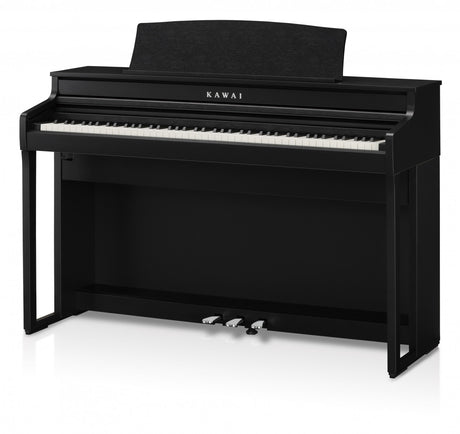
Anyone moving from a grand or acoustic piano to a digital piano often misses one thing first: the feel under the fingers. This is exactly where the digital piano with wooden keys comes in. Instead of all-plastic keys, the white keys here are made of solid wood, mounted on long levers just like in a concert grand.
This guide explains what a wooden keyboard actually adds, which systems the major manufacturers build, from which price range wooden keys begin and for whom the extra cost is worth it.
01What a wooden keyboard changes about the feel
The noticeable difference does not come from the material alone, but from the mechanism behind it. A wooden key is longer than a pure plastic key and sits on a longer lever. As a result the pressure point is distributed more evenly across the whole length of the key, even when playing far back near the black keys.
Three factors work together: the longer levers for a natural key travel, the graded weighting from heavy bass to lighter treble keys, and the wooden side cheeks that give the key stability and a quiet, woody touch noise. Together this comes much closer to the resistance of an acoustic grand than a plastic action does.


02The manufacturer systems at a glance
Each major manufacturer has its own wooden-key concept, and the concepts differ in their construction.
Kawai relies on Grand Feel with solid wooden keys across the full length and particularly long levers, which give the CA series its grand-like feel. Roland combines a wooden core with a plastic coating in the PHA-50, joining wood haptics with the climate robustness of plastic. Yamaha builds white keys of wood with a plastic cap on the key edge into its upper CLP range with GrandTouch and the NWX keyboard.
None of these systems is universally better, they simply set different priorities between pure wood feel and ease of care.
| Manufacturer | System | Construction |
|---|---|---|
| Kawai | Grand Feel | Solid wooden keys, very long levers |
| Roland | PHA-50 | Wooden core with plastic coating |
| Yamaha | GrandTouch / NWX | Wooden keys with plastic cap on the edge |
03From which price range wooden keys begin
Wooden keyboards are more complex to build than plastic actions and therefore only appear from the upper mid range upwards. As a rough guide, models with a real wooden keyboard start at around 1,700 to 1,900 euros and reach well into four figures.
Below that, in the entry and mid segment, manufacturers use very good plastic actions that are entirely sufficient for beginners and daily practice. The step up to a wooden keyboard pays off where the playing feel itself becomes a buying criterion.
A good entry point into the wooden-key world is the Kawai Digitalpiano CA-401, above it sits the Kawai Digitalpiano CA-701 with even longer levers. From Roland, the Roland Digitalpiano HP-704 covers the solid middle, the Roland LX-5 Digitalpiano: Kompakte Eleganz, überlegener Klang the upper segment.


04For whom the extra cost is worth it
Those who benefit most are players already at home on an acoustic or grand piano who want to find that feel again on a digital piano. Advanced players working on dynamics and touch control also notice the difference in everyday playing.
For absolute beginners or for a second instrument played occasionally, a good plastic action is usually the more sensible choice. If in doubt, go by your own playing level: the more practised the hand, the more a wooden keyboard pays off.
A frequent comparison pits the Roland Digitalpiano HP-704 against the Kawai Digitalpiano CA-701 - similar price range, but a different key philosophy. The full selection is in the Digitalpianos category.
05Care and room climate
Wood lives with the room climate. A wooden keyboard is sturdily built, but like any wooden instrument it reacts to strong swings in humidity and temperature. A spot away from radiators, underfloor heating hotspots and direct sunlight protects the action.
Ideally the relative humidity in the living area sits between roughly 40 and 60 percent. During very dry winter months a humidifier in the room helps. The Roland action with plastic coating is the least sensitive here, while Kawai's solid wooden keys benefit most from a stable room climate.
A wooden keyboard is not a must, but it is a noticeable step closer to the feel of the acoustic instrument. Anyone who plays regularly and with ambition will find models in the upper mid range that make this difference noticeable every day.
Frequently asked questions
What does a wooden keyboard on a digital piano really add?
From what price are digital pianos with wooden keys available?
Which manufacturer systems exist?
Is a wooden keyboard worth it for beginners?
Is a wooden keyboard sensitive to room climate?
Discover digital pianos with wooden keys
From a solid entry to the grand-like top tier - the selection at a glance.
View all digital pianosView the Kawai CA-701Passende Produkte