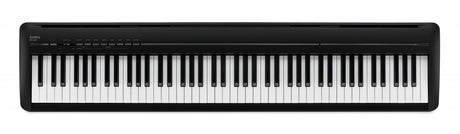
Looking for a first digital piano for music school or the first few lessons at home, the question comes up fast: FP-30X or ES-120 — and how does the Casio PX-S1100 compare? All three are portable stage pianos in the same beginner segment, with 88 weighted keys and built-in speakers, but the technology underneath differs in several places.
This comparison focuses on what actually matters day to day: keybed action, sound, speakers, Bluetooth connectivity, and weight. There is no single winner at the end — the right choice depends on individual priorities.
01The short answer in three sentences
For an instrument that gets carried around a lot — between home and music school, or to rehearsals — the lighter weight of the Casio Stage Piano PX S 1100 - Schwarz makes the difference. For the most headroom on more complex pieces, the Roland Stagepiano FP 30x BK - schwarz matt with 256-note polyphony offers the most reserve. For a balanced middle ground of volume, weight, and wireless connectivity, the Kawai Stagepiano ES 120 - schwarz is the right pick — the sections below explain why.
02Keybed and touch: the biggest technical difference
All three instruments have 88 weighted keys with hammer-action simulation, but the technology inside is not the same. The Roland FP-30X uses the PHA-4 Standard action with escapement (the noticeable resistance point during a slow keypress, like on an acoustic grand) and an Ivory Feel key surface with progressive weighting — heavier in the low register, lighter in the high one, like on an acoustic piano.
The Kawai ES-120 uses the Responsive Hammer Compact (RHC) action, developed specifically for the instrument's compact body, also with different hammer weights depending on register. The Casio PX-S1100 uses Smart Scaled Hammer Action — here, a two-sensor mechanism replaces the three-sensor technology usually found on larger instruments, compensated for with additional computational logic. That is the trade-off Casio makes to achieve such a slim design.
| Model | Keybed | Polyphony | Speakers | Weight | Bluetooth |
|---|---|---|---|---|---|
| Roland FP-30X | PHA-4 Standard, escapement | 256-note | 2 × 11 W (22 W) | just over 14 kg | Audio + MIDI, built-in |
| Kawai ES-120 | Responsive Hammer Compact | 192-note | 20 W system | approx. 12.5 kg | Audio + MIDI, built-in |
| Casio PX-S1100 | Smart Scaled Hammer Action (2-sensor) | 192-note | 2 × 8 W (16 W) | approx. 11.2 kg | Audio + MIDI via included adapter |
03Sound and speakers in everyday use
For everyday practice, raw wattage matters less than the balance between speaker size and the cabinet. The Roland Stagepiano FP 30x BK - schwarz matt has the highest output of the three at 2 × 11 watts and runs Roland's SuperNATURAL sound engine — noticeable as soon as you play without headphones in a larger room. The Kawai Stagepiano ES 120 - schwarz pairs a 20-watt system with Kawai's own SK-EX and EX concert grand samples, sitting between the other two in terms of volume. The Casio Stage Piano PX S 1100 - Schwarz has the lowest output at 2 × 8 watts — in exchange, it is also the most compact and lightest of the three, a deliberate trade-off on speaker size.
For headphone practice at home, speaker output does not matter anyway — all three have a headphone jack, and the Kawai even has two.


04Bluetooth, connections, and what else you need
There is a real difference on the wireless side: the Roland FP-30X and Kawai ES-120 both have Bluetooth Audio and MIDI built in from the factory — connecting to learning apps or streaming audio through the built-in speakers works right out of the box. The Casio PX-S1100 ships with a matching Bluetooth adapter (WU-BT10) in the box, which needs to be plugged in rather than being built in — functionally identical, but one extra piece that should not get lost.
All three instruments have USB-MIDI for connecting to a computer or tablet and a jack input for an optional sustain pedal. None of the three solo units includes a stand or a three-pedal unit — for a ready-to-play setup, the Stagepianos - Bundles category has preconfigured sets with stand, pedals, and headphones for all three models.
05Which model fits which player?
For frequent transport (music school, rehearsal space, an apartment with limited room): the Casio Stage Piano PX S 1100 - Schwarz — at around 11 kg, the lightest of the three, and with slider controls instead of a button menu, also the quickest to operate.
For more demanding repertoire with many sustained notes and heavy pedal use (dense pieces, later advanced-level repertoire): the Roland Stagepiano FP 30x BK - schwarz matt — the higher polyphony lets more notes ring out at once before older ones get cut off.
For anyone looking for a balanced middle ground without a clear weak spot: the Kawai Stagepiano ES 120 - schwarz — a solid balance of volume, weight, and built-in Bluetooth, without falling notably short on any one point.
For all three: 192- or 256-note polyphony is more than enough for beginner and intermediate-level playing — limits only show up on very dense, multi-voice pieces with extended pedal use.
The FP-30X or ES-120 question does not have one universal answer — both are solid beginner stage pianos with different strengths, and the Casio PX-S1100 is an equally valid third option as the lightest and most compact of the three. Prioritizing weight and portability points to the Casio, prioritizing sound headroom for dense pieces points to the Roland, and looking for a balanced middle ground without weak spots points to the Kawai.
Frequently asked questions
Is a stage piano the same as a digital piano?
Do I also need a stand and a pedal?
Is 192-note polyphony enough for a beginner?
Which of the three models is the lightest to carry?
Does the piano sound differ a lot between the three?
Find the right beginner stage piano
Compare all three models directly, or order one as a complete set with stand, pedals, and headphones.
Browse all stage pianosSee sets with accessoriesPassende Produkte